

“So All May Be Fed”: Reflections on Another Summer of RMBL Indigenous Outreach
Above: Southern Ute poet CMarie Fuhrman presenting in the billy barr Community Center this past summer. Photo by John Hausdoerffer, PhD
From our 9,500-foot Gothic perspective, the evening of June 6 in Cortez, Colorado, felt summer-warm as Ute Mountain Ute Elder Norman Lopez welcomed us — 11 RMBL representatives — with a song, his flute blending with his Ute baritone. The team had traveled five hours to learn from and connect with Ute Mountain Ute neighbors celebrating their annual Bear Dance and to thank Ute Mountain Ute Elder Regina Lopez Whiteskunk for her insightful visits to RMBL over the previous two years. The weekend that followed offered striking music, dance, and an expanding sense of the places, people, beings, and perspectives Whiteskunk brings to her visits to RMBL.
The summer of 2026 that followed both expanded and humbled RMBL’s understanding of the complexities inherent in a laboratory co-creating a sense of belonging and inviting traditional ways of knowing back into the Upper East River lands surrounding RMBL. From the June Bear Dance visit to Southern Ute poet CMarie Fuhrman’s July linguistics lecture for RMBL students and researchers to Whiteskunk and Lopez’s return to RMBL in October for a film and further connection, this was a summer of enhanced Indigenous engagement for RMBLers, opening far more questions than it settled.
Bear Dance
The RMBL representatives attending the Bear Dance included Laurent Duverglas; Lucy Myers; Ian Breckheimer, PhD; Ben Wong Blonder, PhD, and his partner, Charlotte; RMBL Board Chair Jen Darnell, PhD; Paul CaraDonna, PhD, and Amy Iler, PhD, with their ever-enthralled daughter, Zoe; David Inouye, PhD; and me. Darnell ran the community’s half marathon (around sacred Sleeping Ute Mountain, starting from the Bear Dance site and circling the area where the Sun Dance would be held later in the summer) before the rest of us arrived.
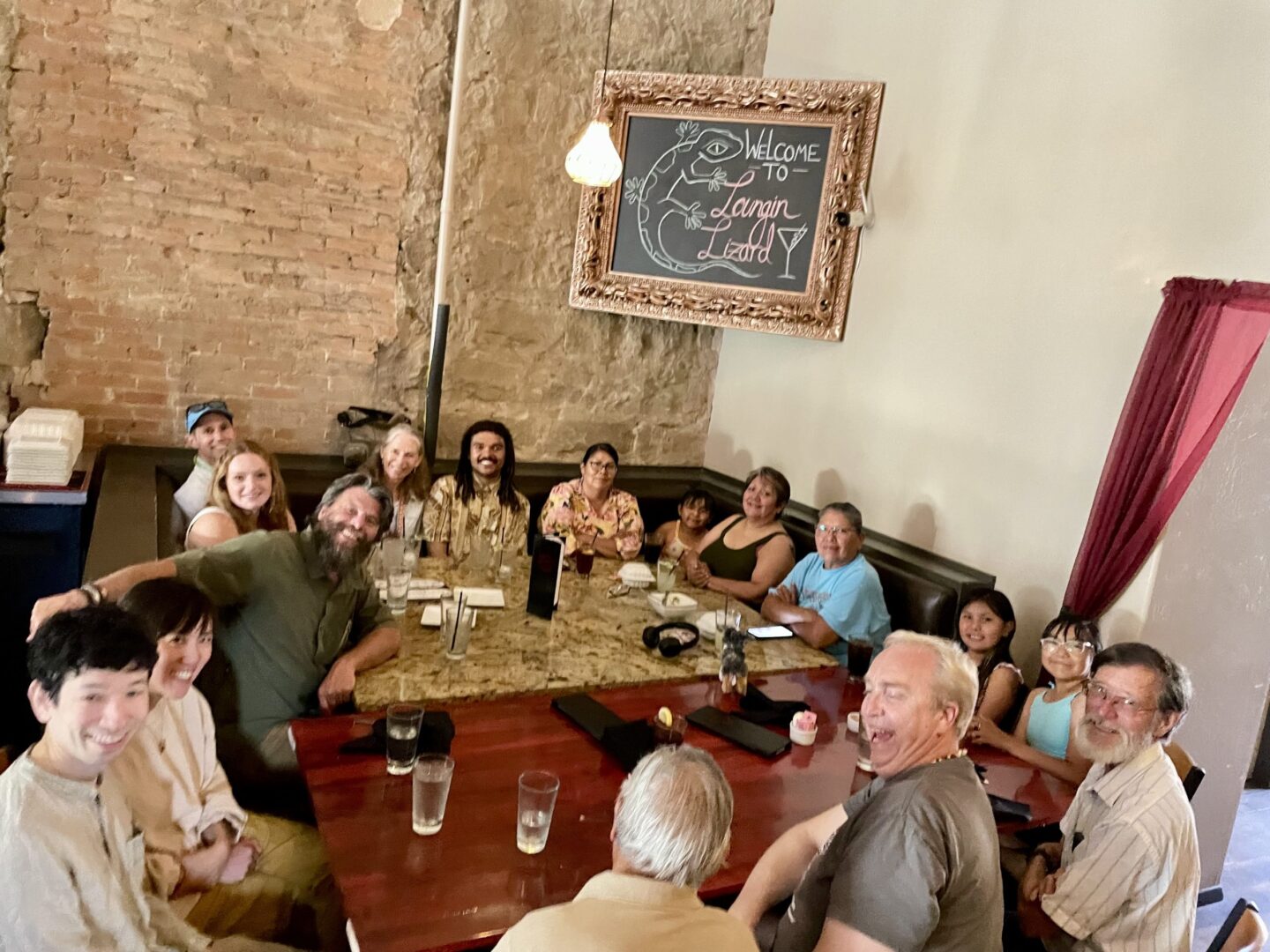
The group gathered for dinner with Whiteskunk and her two granddaughters, Lopez, Ute Mountain Ute Elder Lisa Jacket, and other community members who shared insights into the cultural significance of the dance. The Ute Bear Dance is much more than a traditional performance. It is a living cultural and spiritual practice that expresses the Ute people’s relationship with the natural world, community, and the renewal of life.
First, the Bear Dance takes place in spring, when bears emerge from hibernation. The bear symbolizes this seasonal transition. Second, the dance brings people together across generations. Men and women dance in pairs, with women leading and men following. Beyond courtship, the larger purpose is to strengthen relationships and sustain community. Finally, the Bear Dance originated when a bear shared the dance with a Ute hunter. This story expresses a worldview in which animals are not simply resources or objects of study but beings with knowledge to share.
Although invited to join the circle of dancers, RMBL representatives chose to listen and build friendships on the outskirts of the dance. Perhaps in future years we will feel we have earned enough trust to join. Blonder reflected on the experience: “It was an honor to experience the Bear Dance with Regina and her family. Deepening these relationships and helping RMBL become a stronger community member is a priority for me.”
Following the dance, the RMBL team visited with Travis Custer of the Montezuma Land Conservancy, an organization widely known for its excellence in building co-management partnerships and resilient landscapes with Ute Mountain Ute leaders and youth. Custer stressed patience, listening, and shared knowledge.
After the visit, several RMBL representatives commented on the power of the music (and how much it sounded like those first thunderstorms of spring when bears emerge); how patient and open RMBL visitors must remain as they learn the nuances of Indigenous science, diversity, and expertise within the Ute Mountain Ute community; and how important it is to welcome Ute Mountain Ute expertise, rather than only share RMBL findings, when Ute Mountain Ute representatives visit Gothic and RMBL. Many noted connections with the writing of Robin Wall Kimmerer, PhD, who, in “Braiding Sweetgrass,” reminds scientists to “envision a time when the intellectual monoculture of science will be replaced with a polyculture of complementary knowledges. And so all may be fed.”
Whiteskunk echoed Kimmerer’s philosophy when she reflected on the visit. “It was a big honor to have RMBL here to see the Bear Dance with your own eyes, building a bridge between traditional knowledge and Western science. I hope to braid together a beautiful and creative way to navigate our futures.”
CMarie Fuhrman
In the October 2025 RMBL newsletter, I wrote about Fuhrman’s July 2025 visit to RMBL.
Students and faculty across disciplines asked how to build more authentic relationships with Indigenous communities. Fuhrman reframed their scientific work as a beginning, grounded in RMBL’s nearly century-long observation of plants and animals that the Ute regard as kin.
“The plants are lonely,” Fuhrman explained. “They miss having us sing to them. The deer like to be addressed verbally, personally. Native peoples were and are pollinators here, as are all those who walk through Beargrass with their arms wide open. Keep paying attention as scientists, but also relate as persons, as relatives. With that common ground, we can build relationships across cultures here at RMBL.”
On July 17, 2026, Fuhrman returned. Word got out about her 2025 talk, so we reserved the lecture hall. Nearly 100 people attended. This time, Fuhrman offered a grammar lesson — simple in content yet profound in its implications for conducting science with greater attention to the agency of the species and landscapes that scientists study.
She shared poems using “the” before a plant or animal, others using “a,” and then challenged the audience to consider what happens when a poem drops both. “When you drop ‘the’ as a definite article and ‘a’ as an indefinite article in writing about other beings,” she said, “you discover a less objectifying and more animating connection.”
Fuhrman challenged scientists to imagine changing nothing in their scientific notes or writing except dropping “a” and “the” before naming their subjects. She offered an example: In her reading, “The bear walked across the meadow at 5 a.m.” identifies the bear at the species level yet creates an objective distance that denies the bear’s agency and personhood. “A bear walked across the meadow at 5 a.m.” makes the bear more specific to an individual member of the species, but the feeling of an object of study remains.
“Bear walked across the meadow at 5 a.m.” Dropping both articles leaves us simply with “bear.” When I said it in my head during her talk, I felt as though I was talking about someone I knew. Someone named Bear. Agency and personhood emerge simply by dropping one word. I wish I had followed up with the undergraduate students a few days later to see whether any had tried this shift in the field and whether it had changed their interpretation of their studies (without changing anything about their methods).
RMBL alumna and undergraduate research instructor Kaysee Arrowsmith, PhD, was moved by the talk: “As scientists, we’re trained to be very careful about using words like ‘significant’ and ‘causal’ — words that might misrepresent our data and analyses. But I’ve never thought about the power of articles, and it was a totally new experience to try to think about the power of these little, ubiquitous words. The shift from thinking of organisms as things to thinking of organisms as beings — ‘bear’ with no article — is so aligned with how we view the natural world here at RMBL and yet is such a transformational way of thinking.”
The Exchange: An Emerging Film

In April and July 2026, I traveled to Towaoc, Colorado, the headquarters of the Ute Mountain Ute Tribe, with Emmy Award-winning documentarian Julian Rubinstein. Rubinstein heard about Whiteskunk’s 2025 visit to RMBL, where she toured the Research Meadow with Iler and learned about changes in plant phenology, with some plants showing signs of resilience and others of collapse. When Whiteskunk learned about earlier plant emergence due to climate change, she felt connected to the plants and the pollinators who rely on them.
Whiteskunk has shared that Ute Mountain Ute ceremonies, especially the Sun Dance but also the Bear Dance we attended, traditionally rely on plant species whose availability has been disrupted by climate change. For example, in the harsh late-June sun, the tribe traditionally drapes fresh willow stalks over Sun Dancers. Both the shade and the moisture in the plants cool the dancers. But when Whiteskunk showed us former willow sites once fed by springs that have now dried up on Sleeping Ute Mountain (a few hundred yards from the dance site), she explained that she must leave reservation land, sometimes drive for hours, and negotiate with non-Indigenous landowners just to continue the ritual. Perhaps we should call it cultural phenology: Just as RMBL plants and pollinators are emerging at unpredictable times due to climate change, the plants necessary for Ute Mountain Ute ceremonies are also being disrupted by climate-driven drought.
Rubinstein, who will serve as director and co-producer; Whiteskunk, who will serve as co-producer; and I are working on a film to capture the exchange Whiteskunk hopes to foster between RMBL scientists and Ute Mountain Ute elders — an effort to understand and adapt to what is happening with plants, from Gothic to Towaoc. How? Rubinstein finds both the story of Inouye’s plant challenges at his home in Paonia, Colorado (his orchard collapsed in a late frost after its blossoms emerged too early during a warm March 2026), and Inouye’s half-century of work on plant phenology at RMBL compelling. Rubinstein has filmed Whiteskunk at her home in Towaoc and Inouye in Paonia. Each shares a distinct yet complementary perspective and way of knowing plants — and why they matter — in the age of climate change.
Finally, Rubinstein filmed Whiteskunk and Inouye gathering in Gothic Oct. 9-11, 2026. Just a few aspen leaves remained, and the first snows dusted Avery Peak. Whiteskunk brought her father, Norman Lopez (who once sang to bless the ground on which the National Museum of the American Indian in Washington, D.C., now stands), her husband (artist Robert Bancroft), and her daughter and granddaughters. Lopez immediately felt something, later sharing, “When I arrived, I felt their presence. Our ancestors were watching, so I knew I had to speak Ute and play my flute.”
In misty weather, Inouye led Whiteskunk around the Research Meadow and down to an important willow study site. Throughout, they talked informally, learning together about plants, climate change, and the intersection of ecological and cultural resilience.
I will not offer any film spoilers. We will all need to wait for Rubinstein’s film to learn about some of the grounded yet stirring interactions and connections that happened over the weekend. But I will share this. Whiteskunk was reflecting on what it felt like to return to Gothic for a third time, what she calls “homecoming,” this time with four generations of her family. Her words should continue to spark RMBLers’ curiosity and inspire patience and cultural humility: “This homecoming is really an awakening. An awakening both in our sense of this land and in this land’s response to us coming home.”
— John Hausdoerffer, PhD
Director of Story
Rocky Mountain Biological Laboratory